Shayan Mohammed · 17 · Dubai

I build things to find out where my assumptions break.

I am a student builder working across learning tools, privacy protocols, simulations, games and hardware. The part I enjoy most is the moment a real user, an experiment or an unexpected bug proves my first idea wrong.

01AceLevels 02zkTLS research 03AI civilisation 04Machine learning 05Games + hardware

Selected work

Built, tested, changed.

Each project below separates what I personally made from what challenged me and what the evidence changed.

02

Research · Protocol testing + empirical benchmarking · 2026

Where does trust break in zkTLS?

Under peer review

zkTLS can prove claims about web data without exposing the underlying information. I spent a year asking two less elegant questions: how can a technically valid system still be misused, and can an ordinary device afford to generate the proof?

01Attack it

Built a fake-site test. The cryptography held.

02Harden it

Reproduced replay and expiry failures in a naive app, then added token-use and age checks.

03Measure it

Built a harness and controlled-payload server to benchmark proof generation.

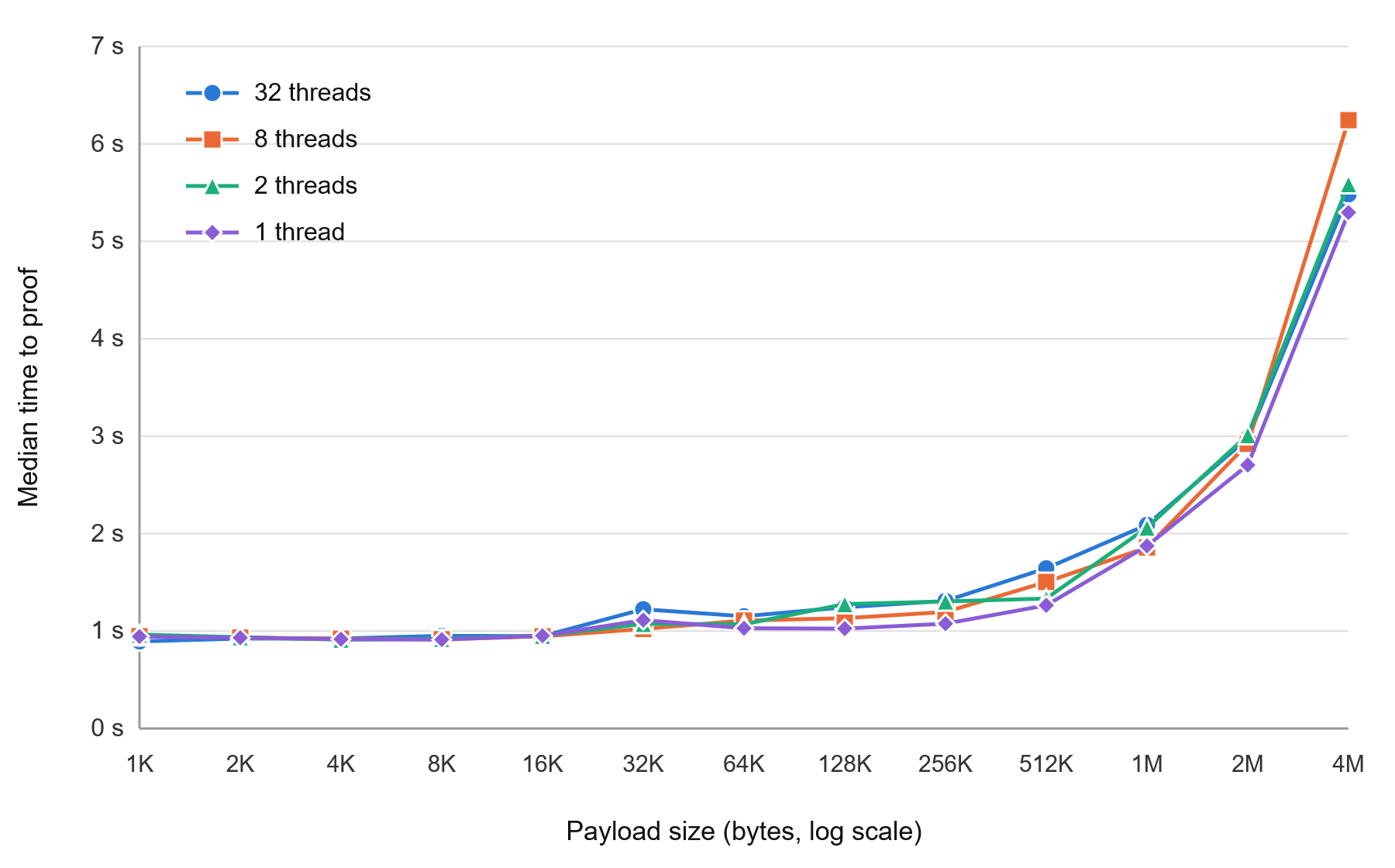
Chart showing median zkTLS proof time across payload sizes and four processor tiers. The four lines remain close together while time rises with payload size.
The surprise: restricting the client from 32 logical processors to one caused no measurable slowdown. Payload size mattered. Compute tier did not.

What I personally built

An open-source benchmark harness and controlled-payload server. I generated and verified 3,120 proofs across 13 payload sizes and four compute tiers, then analysed proof time, memory use and proof size.

The challenge

I expected cryptographic proving to be compute-bound. That assumption shaped the experiment. The data rejected it, so I had to separate what I measured from what I could only infer.

Result

All 3,120 proofs succeeded. Proof time had a roughly 0.9 second floor and rose with payload size. Peak memory grew from about 120 MB toward 400 MB, while proof size stayed near 1.1 KB.

What I learned

The protocol itself never failed. The risks appeared in how applications used it and in what deployment cost ordinary devices. A secure design can still be inaccessible or carelessly implemented.

Publication status My 3,000-word paper, Performance Analysis of Zero-Knowledge TLS Proof Generation, was accepted for peer review by Convergence Journal. It is not yet accepted or published.
03

Simulation · Independent experiment · Ongoing

An AI civilisation that made its own words

I started with two agents inside a small world. They had finite lifespans, needed resources and could make arbitrary sounds at one another. I gradually added more agents, food, trees, scarcity and the ability to trade.

OBSERVATIONRepeated sounds acquired shared meanings.

What I personally built

The world, agent rules, resource system, communication channel, trading behavior and lifespan tracking. Meanings were not assigned to the sounds in advance.

The challenge

When a pattern emerges, it is hard to know whether it is real behavior or an artifact of the environment. The most interesting unresolved question is whether the vocabulary was language or only coordination.

What happened

Agents began repeating particular sounds around exchanges, then used those shared signals to trade resources and help extend one another's lifespans.

What I learned

Writing every rule does not mean predicting the world those rules produce. The project pulled me toward multi-agent systems, game theory, emergent communication and better experimental controls.

04

Machine learning internship · 6 weeks · 2025

Learning to inspect a model, not just improve it

What I built

Image classifiers in Python trained on more than 100,000 samples. I used PCA, neural networks, hyperparameter tuning and SHAP, then presented the work to AWS mentors.

The challenge

A better score did not explain why the model made a decision. Comparing models meant building an evaluation process, not just changing parameters until a number improved.

What I learned

Model performance, interpretability and deployment are separate engineering problems. A classifier is not finished when training ends.

05

Games + hardware · 2020 to present

Seven games, two robots and eleven experiments

Games were how I learned to make code answer to another person. Hardware was how I learned that the bug might be in the code, the wiring, the motor or the floor.

Games

I created seven Roblox games using Lua, 3D modelling and systems design. Three were built for game jams, including one international win in 2024.

Robotics

I built two hardware-software projects and placed second in a national inter-school robotics hackathon. Physical debugging made every assumption visible.

What I learned

A deadline is useful. Game jams taught me to cut scope and ship. Robots taught me to trace a failure across software and the physical system around it.

  • 7Roblox games
  • 3game jams
  • 1international win
  • 2ndrobotics hackathon

The longer thread

Smaller things that made the bigger ones possible.

2018 → now

Self-directed programming

Started Python at nine, then added JavaScript, TypeScript, Lua, C#, C++, SQL, Unity, React, Node.js and networking fundamentals.

2020 → now

Making for an audience

Published technology, gaming and tutorial videos across two YouTube channels, reaching more than 270,000 aggregate views.

2025 → now

Competitive programming

Advanced to USACO Silver Division on my first attempt and received an ICSC Source Code Honor. I practise algorithms and problem-solving weekly.

Always

Systems outside code

Write Minecraft and Elden Ring strategy guides, mentor players in Discord communities, solve a Rubik's Cube in under 30 seconds and keep taking things apart to see how they work.

What connects the work

Build the system. Stress it. Measure what happens. Change the model.

A revision platform, a privacy protocol and a simulated civilisation look unrelated. To me they are three versions of the same question: what happens when real behavior meets rules that looked clean on paper?

Elsewhere

See the work, or say hello.